
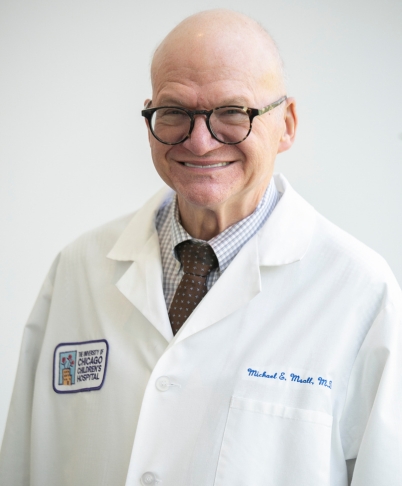
Dr. Michael Msall is the 2026 recipient of the Martha Bridge Denckla Award, recognizing his contributions to the field of neurodevelopmental disabilities for more than 40 years.
Dr. Msall’s path into neurodevelopmental disabilities was cemented the day after his high school graduation, when his sister Christianne was born premature and with a genetic condition. Dr. Msall is the oldest of nine children (Christianne being the eighth), and his role as eldest brother is one he has always taken with the greatest sincerity. His approach to neurodevelopmental disabilities—both in terms of his focus on cognitive, adaptive, and social function and the compassion and thoughtful optimism he brings—was defined from the start by Christianne’s outcomes that far exceeded her physicians’ initial expectations. Following this passion, he began his training in Baltimore with Arnold Capute in 1985 at what is now called the Kennedy Krieger Institute and was mentored by Mark Batshaw and Marilee Allen.
Dr. Msall’s career has taken him to multiple institutions, and he has made a profound impact on each. From 1985 to 1995, he was an associate professor and division chief at Children’s Hospital of Buffalo/SUNY at Buffalo, where he began his lifelong contributions to systems of care for children with disabilities, including cerebral palsy, intellectual disability, and autism. He implemented a consultative model of care with primary care physicians and pediatric nurse practitioners through collaborations with United Cerebral Palsy, The Arc, and People Inc. Dr. Msall has continued to develop systems of care focusing on function, enablement, and family well-being throughout his career. For the past two decades, he has co-chaired the Medical Advisory Board of Pathways.org, led by the Ryan family. The goal of this foundation is to increase recognition of developmental delays through family–health professional collaboration and to implement evidence-based practices. In 2025, there were 69 million web users of Pathways.org educational materials.
At Brown University—the site of his earlier general pediatrics training—Dr. Msall was head of the Child Development Center and Professor of Pediatrics and Human Development. With interdisciplinary colleagues, he emphasized understanding the role of physical, neurological, and behavioral health on indicators of neurodevelopmental functioning across preschool, middle childhood, adolescent, and young adulthood. His passion for community collaboration was highlighted by his serving as Board President of Rhode Island Kids Count for five years.
Since 2003, we have been fortunate to have Dr. Msall in the city of Chicago, at the University of Chicago and Comer Children’s Hospital, where he has served as Section Chief of Developmental-Behavioral Pediatrics, Associate Director of the Kennedy Research Center on Intellectual and Neurodevelopmental Disabilities, and Program Director of the Fellowship in Developmental and Behavioral Pediatrics (DBP). He has trained more than 200 developmental pediatricians, child neurologists, pediatric physiatrists, medical-pediatric and rehabilitation professionals, and advanced pediatric nurse practitioners to improve early identification, child functioning and participation, and family well-being among children and adults with neurodevelopmental disabilities. He has been a mentor to more than 38 DBP fellows and has trained a significant plurality, if not the majority, of DBPs currently practicing in the city of Chicago.
Dr. Msall has turned copious and consistent funding into more than 260 papers; his initial first-author paper was published in the New England Journal of Medicine. Perhaps his best-known contribution has been the development of the Functional Independence Measure for Children—better known as the WeeFIM—which is the world standard for pediatric functional measures. This work combines the focus on motor, self-care, communicative, and social function during daily activities at home and school. Much of these perspectives are informed not only by interdisciplinary colleagues in psychology, child development, neuropsychology, and rehabilitation sciences but also by his lived experience caring for his sister with developmental disabilities. He has brought the quantitative rigor of his undergraduate training in mathematics from Northwestern University. Dr. Msall subsequently expanded the field’s function-measurement repertoire through the Warner Initial Developmental Evaluation of Adaptive and Functional Skills and the Child Health Impairment–Functioning, Participation and Satisfaction Checklist. These adaptive measures have helped inform long-term outcomes in large studies covering a broad range of conditions.
However, function is only one aspect of the truly patient-oriented and family-centered perspective that Dr. Msall has brought to neurodevelopmental medicine. For example, his Child Disability and the Family project, funded by NICHD, examined the role of disability in parental employment, family finances, sibling well-being, and social support, anticipating now commonly discussed advances in this area by several decades. Most recently, he was co-editor with Paige Church for the July 2026 issue of Pediatric Annals that described the impact of a neurodiversity framework emphasizing cognitive, motor, developmental, and sensory strengths that inform resilience and participation. This framework was applied to children with intellectual disability as well as autism, deafness, children with disabilities in low- and middle-income countries, and health professionals with Tourette’s or ADHD.
These are just highlights, and what cannot be overestimated is the overwhelming range of areas in which he has made substantive contributions to advocacy, teaching, clinical care, and research, including cerebral palsy, intellectual disability, premature development, population studies, and many others. Colleagues are divided on whether he has secretly developed a time machine that gives him 27 hours in his day or just never sleeps.
The Denckla Award is only the most recent in a long line of prominent awards recognizing Dr. Msall’s field-changing contributions from many different organizations and societies. Recent awards include the Arnold Capute Award from the American Academy of Pediatrics, the C. Anderson Aldrich Award for Lifetime Achievement from the AAP Section on Developmental-Behavioral Pediatrics, the Jane Sweeney Award from the Academy of Pediatric Physical Therapy, the Frederic W. Schlutz Award for Lifetime Achievement from the University of Chicago Department of Pediatrics, the Mentor Award from the American Academy for Cerebral Palsy and Developmental Medicine, the Jonas Salk Health Leadership Award for Research from the March of Dimes, and the Sir James Carreras International Variety Club Award for Physician Leadership in Neurodevelopmental Disabilities. Dr. Msall has also been a consistent contributor to the American Pediatric Society and the American Academy of Cerebral Palsy and Developmental Medicine.
Anyone fortunate enough to attend Michael’s talks and presentations over these many years may remember an ever-present slide of his three little kids, bundled up in snowsuits on the back deck of the Buffalo house, ready for action with their dad. Those children—who learned the value of hard work and caring for others from their father—are now the age Dr. Msall was at Hopkins and the University of Buffalo.
Michael is very much looking forward to biking on the Chicago lakefront with Nicholas, beachcombing in Rhode Island at his favorite Goosewing Beach with Jennie and her husband, Jeff, and taking long walks through Brooklyn neighborhoods with Emily.
And playing more accordion. Many, many family members, friends, patients, and their families have been serenaded over the decades with Christmas carols, polkas, children’s songs, happy birthday tunes, folk songs, activist anthems, and many more. Many others will be serenaded for years to come.