
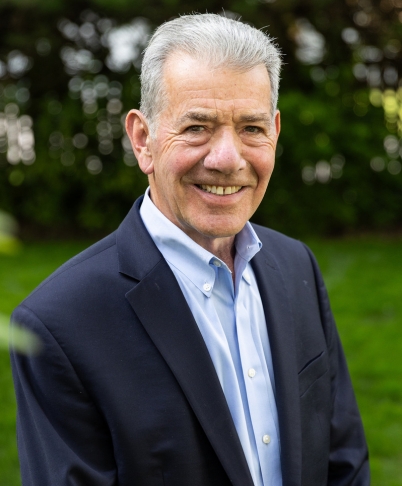
Listen, care, act. In those three words, colleagues, patients, families, and trainees might find the essence of Dr. Lawrence W. Brown’s career in child neurology. Across more than four decades in academic medicine in Philadelphia, including 34 years at the Children’s Hospital of Philadelphia, Dr. Brown became known for uncommon clinical range, deep humanity, sustained mentorship, and a lifelong instinct to repair what is unfinished in the world around him.
Dr. Brown grew up in New York and attended Great Neck South High School before going on to Brandeis University and New York University School of Medicine. He completed pediatrics residency and child neurology training at CHOP, where he later returned to build much of his professional legacy. From the beginning, he was drawn to what he has called the “daily miracles of development”—the ways children become thinking, thoughtful adults capable of agency.
His path was shaped by mentors who recognized both his curiosity and clinical gifts. In medical school, Dr. Eric Kandel pointed him toward neurology over psychiatry. As an intern, Dr. Peter Berman, chair of child neurology at CHOP, offered him a residency without a formal application and became a defining influence and lifelong friend. When Dr. Brown identified the first case of infant botulism on the East Coast, Dr. Berman insisted that the young resident take credit and present the findings himself at the CNS meeting and beyond.
That early experience reflected two themes that would follow him throughout his career: careful clinical observation and generous mentorship. Dr. Berman later described him as a “consummate generalist,” a phrase that captures both the scope and spirit of Dr. Brown’s work. If Dr. Brown were still in clinical practice at CHOP today, one colleague observed, he might simultaneously practice in the subspecialties of epilepsy, behavioral neurology, movement disorders, headache, and community neurology. His clinical experience was broad and deep, and students at all levels described him as an excellent teacher across many topics in child neurology.
From the start, Dr. Brown gravitated to disorders bridging neurology and psychiatry. After early work in infant botulism, his interests expanded to infant apnea and sleep medicine. During a decade as chief of child neurology at the Medical College of Pennsylvania, now Drexel University, he consulted at three psychiatric facilities across greater Philadelphia. Later, after returning to CHOP as co-director of the epilepsy program, he partnered with Dr. Anthony Rostain to establish a regional pediatric neuropsychiatry center for children with Tourette syndrome, autism, ADHD, and behavioral manifestations of neurological and genetic disorders.
Dr. Brown’s research and clinical leadership reflected that same breadth. He served as a senior clinician in CHOP’s Pediatric Regional Epilepsy Program, where he was principal investigator on numerous drug trials. Beyond epilepsy, he participated in clinical trials of medications for Tourette syndrome and ADHD. He was also a senior clinician at CHOP’s Sleep Disorders Center, with a particular interest in how sleep and sleep disorders affect children with neurological and developmental conditions. He contributed to national ADHD guideline work through the American Academy of Pediatrics and updated ADHD treatment guidance for the British Medical Journal for many years.
Yet for many who know him, Dr. Brown’s greatest legacy lies in the way he cared for patients and taught others to care. Colleagues describe a physician who was clear, honest, and empathetic at once. He could summarize essential clinical truths in a few sentences, then talk with families long enough to ensure they were understood and that they understood. His notes were brief but packed with useful information, making it easier for colleagues to care for his patients.
The depth of that listening is reflected in families’ memories. One mother recalled a first visit for her son Andrew with intellectual disability and refractory epilepsy. He did not typically communicate verbally, but 10 minutes after being asked about lunch, he said, “turkey.” Dr. Brown retorted, “And who are you calling turkey?” That small exchange told the family that his neurologist saw Andrew as a person, not a diagnosis. When Ann asked whether they would “become a number” at CHOP, Dr. Brown looked at her for a long moment before shaking his head no. For the next 30 years, that promise held as Dr. Brown accompanied Andrew and his family through every step of a challenging epilepsy journey: medications, the ketogenic diet, corpus callosotomy, and vagus nerve stimulation. From optimism to uncertainty to disappointment and back again, the adults talked through every decision together, but Dr. Brown always turned his full attention to Andrew. Ann later wrote to Dr. Brown thanking him for the hope and encouragement to keep trying. “You were our anchor in this fierce storm called epilepsy. Your optimism, wise guidance, and the way you made us feel heard meant everything to us.”
Dr. Brown would do whatever it took to establish a good relationship with patients. More than once, Ann called to report that Andrew had swiped the stethoscope that calmed him and allowed examination. (After the first time, he kept a spare in a drawer.) Similarly, Dr. Brown would cede his chair and computer to Adam, a boy with nonverbal autism, to allow him to call up the cartoon video that helped him relax and cooperate.
This gift for connection extended to colleagues and trainees. Dr. Brown’s door was always open to residents, fellows, and faculty. Former trainees recall that he listened intently, offered an opinion, and often added a vignette or article that made the lesson memorable. Even in retirement, he continued to advise mentees about challenging cases and career decisions. Dr. Alyssa Rosen, who took over the care of many of his complex neurobehavioral patients, reflected that he “really and truly enjoyed his patients and their families,” and former patients often ask about him as if he were a longtime friend or family member.
His commitment to service was equally expansive. His honeymoon (after the second year of medical school) was 8 weeks in rural Appalachia working with a general practitioner. Over the years, Dr. Brown chaired the Neurology Section of the American Academy of Pediatrics, chaired the finance committee of the CNS, and was president of the Child Neurology Foundation (CNF). He was chosen three times as a mentor and leader at the Palatucci Advocacy Forum, chaired local medical advisory boards for the Epilepsy Foundation and Visiting Nurse Society, and served for 15 years on the Data Safety Monitoring Board for the Best Pharmaceuticals for Children Act.
One of his most enduring contributions started with an AAN Palatucci project to create a medical transition program for youth with epilepsy between CHOP and Penn. That project evolved into a signature national initiative for the CNF and helped make child neurology the first pediatric specialty to develop specialty-wide guidelines for successful medical transition. It also contributed to the creation of the American Academy of Neurology Section of Adults with Developmental Disabilities. Among his publications, Dr. Brown is especially proud of the report from that CNF project on medical transition, which brought together child neurologists, adult neurologists, social workers, advocates, patients, and others.
Another favorite is his farewell message to young child neurologists, “Saving the World, One Patient at a Time,” in which he distilled wisdom gathered across a lifetime of practice. That title resonates with another phrase colleagues associate with Dr. Brown: Tikkun Olam. One colleague recalled hearing him say that he lived by the precept of “repairing the world.” The phrase did not need an explanation for those who knew him. It was evident in how he placed the welfare of patients, families, colleagues, and anyone who crossed his path above his own convenience. His influence, that colleague wrote, returns as a reminder of kindness, wisdom, and the joy of being alive.
Dr. Brown’s family life has been a source of pride and grounding. His wife, Dotty, built a distinguished journalism career, including more than 30 years at The Philadelphia Inquirer, where she served in roles including medical editor and edited a Pulitzer Prize-winning series on end-of-life care. Together, they have three daughters—Jordana, Rebecca, and Naomi—and six grandchildren.
Travel and physical activity have been constants throughout his life. Dr. Brown has skied throughout the American West and Europe, hiked across northern England, biked through Normandy and Brittany, and continues to travel internationally with a focus on people-to-people experiences. Since retirement, he and Dotty begin most mornings with classes at their local Y. He remains active in medicine with occasional peer reviews of journal articles and books. He is also working to address unresolved issues of transition for individuals with developmental disabilities through a local nonprofit committed to meaningful vocation, social opportunity, and community for adults.
Dr. Brown has often said, “The only way to show who you are is to be who you are.” By that measure, his career has been its own testimony. He has been a clinician of unusual breadth, a teacher whose lessons endure, an advocate for patients across the lifespan, a mentor to generations, and a physician whose presence made families feel seen. The Roger and Mary Brumback Lifetime Achievement Award recognizes lifelong commitment to child neurology, patient care, and humanism in medicine. Dr. Brown’s life and work have embodied all three.